Property Transfer in KP: Registry, Intiqal, E-Registry and Fees (2026)
Property transfer in KP step by step: the e-stamp, the e-registry at the Sub-Registrar, the intiqal, and BoR's published taxes and fees.

In short
Buy the e-stamp paper first: generate Challan Form 32-A on estamping.kp.gov.pk and pay at a Bank of Khyber branch. Start the e-registry on the same portal with the e-stamp ID, then visit the Sub-Registrar with two witnesses. On 18 August 2026, BoR said the e-registry ran in 11 districts, Peshawar included. The Gazette of 15 October 2026 recognises the e-registry's electronic records where it is in place. BoR lists 1% stamp duty, 0.5% registration fee, 1% CVT and 1% local council tax on a registered transfer (FY 2025-26). The mutation (intiqal) follows. At a Service Delivery Centre (SDC), a Revenue Officer attests it biometrically.
Property transfer in KP (Khyber Pakhtunkhwa) has two official steps: the sale deed is registered at the Sub-Registrar's office (the registry), and the sale is then entered in the revenue record as a mutation (intiqal). Since December 2025 the registry has been moving online, and on 15 October 2026 the province changed its registration rules to give that system's records legal standing. This guide follows the Board of Revenue's (BoR) own notifications and portals, checked on 4 November 2026.
Step 1: Check the record before you pay
Ask the seller for a fresh e-Fard and scan its QR code. Our KP e-Fard guide covers how the seller gets one and what to match.
Step 2: Buy the e-stamp paper
BoR's E-Stamp Project page gives the steps: fill in Form 32-A online, print it, "pay the required stamp duty at the bank", and get the e-stamp paper there.
The challan form asks for the district and the applicant's name, CNIC and phone number. Anyone can check an e-stamp with its number on the portal's E-Verify page. BoR's notification of 15 October 2025 bans manual payment for fard fee, mutation fee and e-stamp: "all payment for digitized services shall be made through cashless system."
Step 3: Register the sale deed (the registry)
Where the e-registry runs
BoR announced the e-registry's launch in Peshawar, its pilot district, from 17 December 2025, saying "a complete ban on manual registries will come into effect in Peshawar". On 18 August 2026, BoR said the system was operational in Peshawar, Bannu, Kohat, Dera Ismail Khan, Abbottabad, Swat, Mardan, Lakki Marwat, Tank, Nowshera and Charsadda. BoR said in December 2025 that the other districts would follow "with schedules to be issued separately", and the portal's e-registry form lists 18 districts (checked in a browser on 4 November 2026). A district on the form may not mean its office is live, so ask the Sub-Registrar.
The steps
BoR's E-Registry User Manual (15 December 2025) describes the citizen's part:
- Initiate E-Registry on estamping.kp.gov.pk with the e-stamp paper ID and the district.
- Check the parties taken from the challan and add any missing one. The system requires two witnesses.
- Enter each party's share, partial or full.
- Write the deed (waseeqa). For property in a city area, enter its east, west, north and south boundaries.
- Upload supporting papers, such as the fard or a court decree.
- Pay the KPITB service charge, at a Bank of Khyber branch or online through Paymir. We found no published amount.
- Visit the Sub-Registrar's office with your witnesses to submit the e-registry.
At the office, the SOPs of 16 December 2025 say the Sub-Registrar identifies the executants and witnesses through CNIC and, where applicable, NADRA biometric verification, once BoR's MoU or SLA with NADRA is finalised. The Sub-Registrar records the admission of execution in the system and approves or refuses the registration. A deed whose stamp duty "cannot be duly verified" is not admitted. A registered deed gets a digitally signed Certificate of Registration, and certified copies carry "a unique QR code or other secure verification mechanism".
We walked the portal's forms without submitting anything; the office steps could not be checked online.
What the Gazette of 15 October 2026 changes
An Inspector General of Registration notification of 5 October 2026, published in the Extraordinary Gazette on 15 October 2026, amended the West Pakistan Registration Rules, 1929. Among the changes:
- Where an e-registry system has been implemented, "the statutory registers may be maintained in electronic form" (rule 57(4)).
- Admission of execution recorded electronically before the registering officer under a notified e-registry, in accordance with sections 34 and 35 of the Act, "shall be lawful admission" (new rule 58-A(1)).
- Certified copies issued electronically and digitally authenticated through the notified system are deemed certified copies under section 57 of the Registration Act (rule 58-A(3)).
BoR describes the result as "a secure, reliable and paperless registration mechanism". The amendments apply where the e-registry is notified or implemented; they don't by themselves move every office online.
Step 4: The mutation (intiqal)
The sale is then entered in the revenue record as a mutation. BoR's page on its Service Delivery Centres says "All mutations are biometrically attestation by Revenue Officer". BoR names 29 centres; our land record offices page lists the SDC portal's centres by district, and you can book a visit on the SDC appointment portal. We found no BoR source on where a mutation is attested in a district without a centre; ask the district's revenue office.
BoR's mutation fee notification of 11 July 2024 (in force from 1 July 2024) sets the fee by how the land is transferred:
| Transfer | Mutation fee |
|---|---|
| By inheritance, by partition, or by gift to a legal heir | No fee |
| In pursuance of a duly registered deed | Rs100 up to 5 kanals, and Rs50 for each kanal above 5 |
| By any mode not listed in the notification (exchange, dower and court decrees have their own entries) | 1% of the value of the property |
The 1% fee is charged if the mutation is accepted, and a gift to anyone other than a legal heir pays it too.
Rates as of November 2026.
Taxes and fees on a property transfer in KP
BoR's Taxes/Fees page lists these for FY 2025-26:
| Tax or fee | Transfer by registered deed | Transfer by mutation |
|---|---|---|
| Local council tax | 1% | 1% |
| Registration fee | 0.5% | none |
| Stamp duty | 1% | none |
| Mutation fee | none listed (Rs100 up to 5 kanals, see Step 4) | 1% |
| Capital value tax (CVT) | 1% | 1% |
The notifications behind them:
- Stamp duty: BoR's letter of July 2024, implementing the KP Finance Act 2024, changes "Two rupees" to "One rupee" per hundred in Article 23 (conveyance), clauses (a) agricultural land and (b) immovable property in an urban area, of Schedule I of the Stamp Act. Clause (c), "any other case", is not in the letter.
- CVT: the same letter changes "Two percent" to "One percent" against serial No. (i), property whose value is recorded, in section 2(2) of the KP Finance Act 2010.
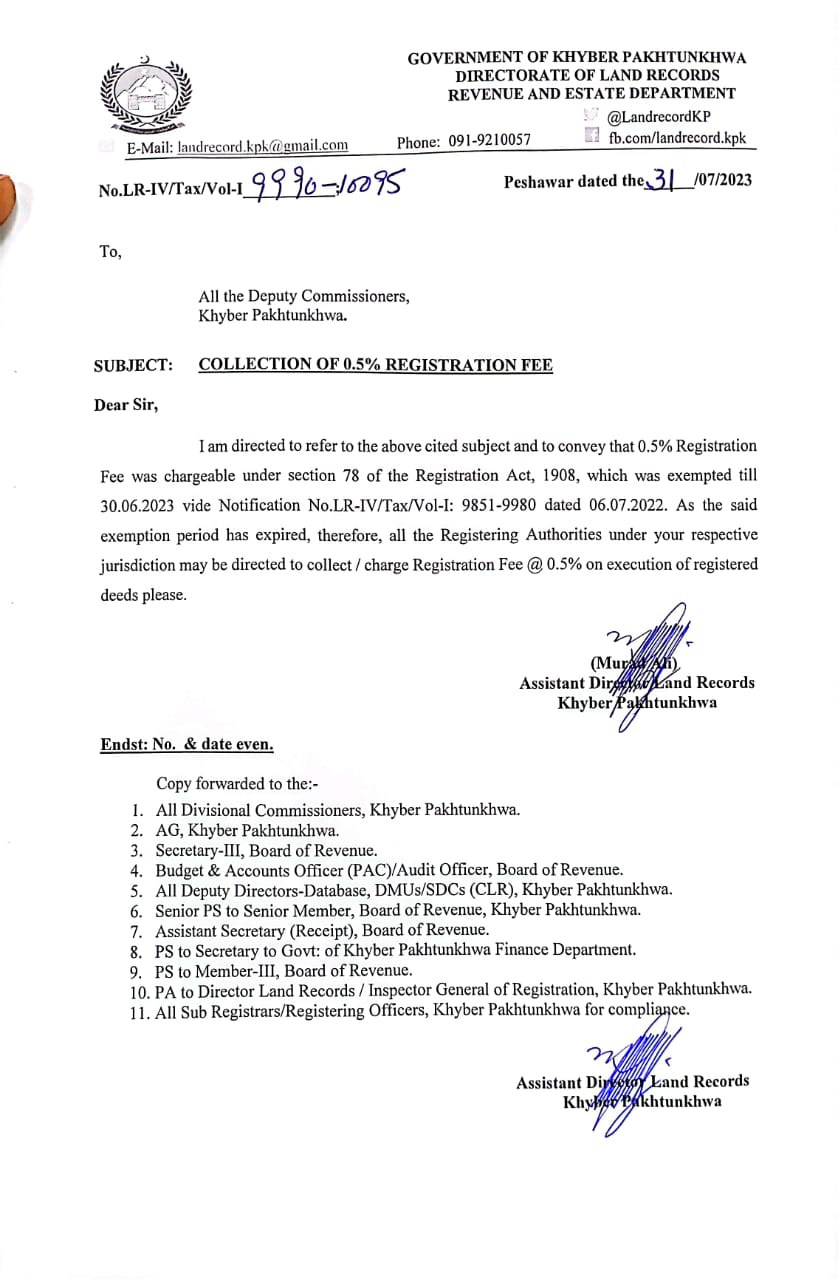
- Registration fee: the Directorate of Land Records' letter of 31 July 2023 directs that the 0.5% fee under section 78 of the Registration Act be collected again, as the exemption ended on 30 June 2023.
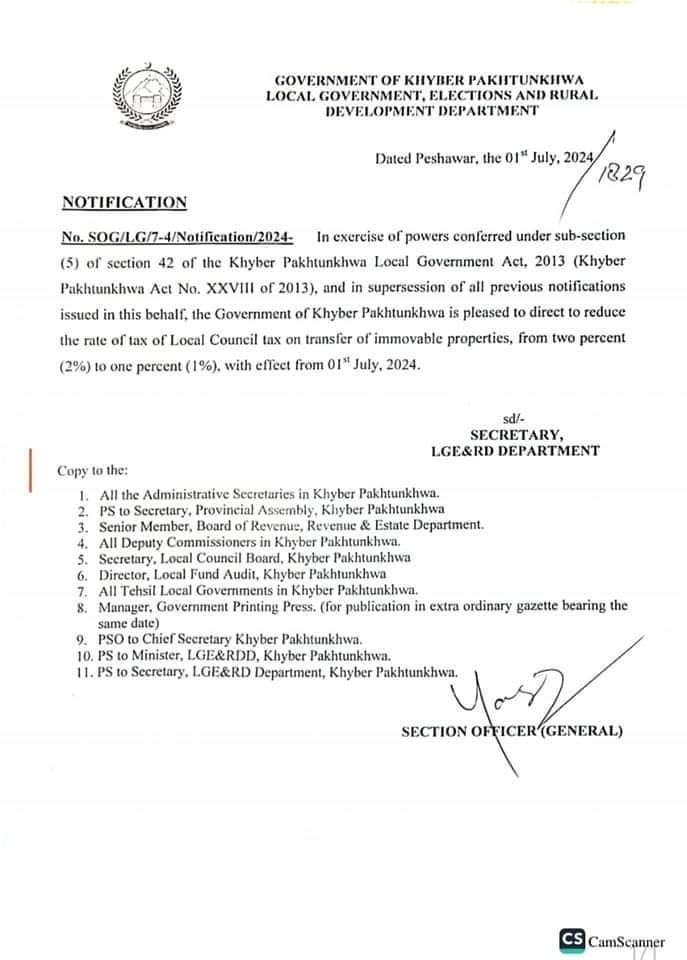
- Local council tax: the Government of Khyber Pakhtunkhwa cut it, by a Local Government Department notification, "from two percent (2%) to one percent (1%)" from 1 July 2024.
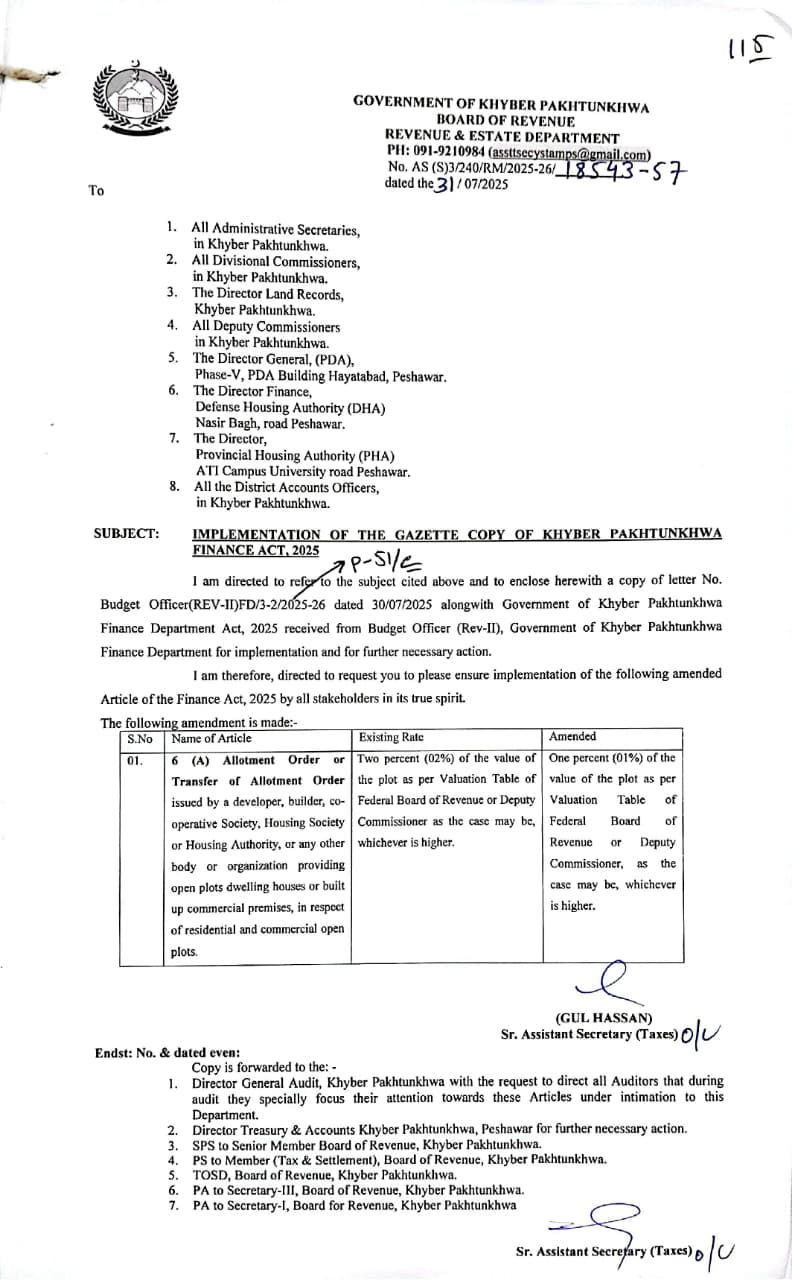
We read the KP Finance Act 2026 (Act XIII of 2026); it does not amend the Stamp Act or the CVT. For an open plot allotted by a developer, housing society or housing authority, BoR's letter of 31 July 2025, implementing the KP Finance Act 2025, sets stamp duty on an allotment order, or its transfer, at "One percent (01%) of the value of the plot" as per FBR's or the Deputy Commissioner's valuation, whichever is higher.
FBR's advance taxes on the seller (236C) and the buyer (236K) are separate. Work them out on our property transfer tax calculator.
Rates as of November 2026.
Frequently asked questions
How do I do property transfer in KP?
Buy the e-stamp, register the sale deed at the Sub-Registrar's office, then have the mutation entered in the revenue record.
Registry KP online ho sakti hai?
Partly, where the e-registry runs. You start it online, but the parties and two witnesses still go to the Sub-Registrar's office.
What is KP e-registration?
BoR's electronic registration system for Sub-Registrar offices. The Gazette of 15 October 2026 recognised its registers, admissions of execution and certified copies where it is implemented.
Intiqal KP mein kahan hota hai?
Where your district has a Service Delivery Centre, a Revenue Officer attests the mutation there biometrically. Book a visit on kplr.gkp.pk.
What is the property transfer fee in KP?
BoR lists, for a registered transfer in FY 2025-26: 1% stamp duty, 0.5% registration fee, 1% CVT and 1% local council tax. The mutation that follows a registered deed costs (BoR, July 2024) Rs100 up to 5 kanals, plus Rs50 for each kanal above 5. FBR's 236C and 236K are extra.
What is stamp duty in KP?
1% for a conveyance of agricultural land or of urban property (BoR, July 2024). For prices, see our Peshawar property guide and all Peshawar guides.
Sources
- Board of Revenue Khyber Pakhtunkhwa: Amendments to the West Pakistan Registration Rules, 1929 (news, 15 October 2026) revenue.kp.gov.pk
- Khyber Pakhtunkhwa Government Gazette, Extraordinary, 15 October 2026: IGR notification No. LR-VIII/Registration-Rules Amendment/24117 of 5 October 2026 res.cloudinary.com
- Board of Revenue Khyber Pakhtunkhwa: E-Registry System to be launched from 17 December 2025, Peshawar pilot (news, 11 December 2025) revenue.kp.gov.pk
- Board of Revenue Khyber Pakhtunkhwa: SOPs for the E-Registry system in Sub-Registrar Offices, No. BOR/E-Stamp/E-Registration/30967-76 of 16 December 2025 res.cloudinary.com
- Board of Revenue Khyber Pakhtunkhwa: E-Registry operational in 11 districts (news, 18 August 2026) revenue.kp.gov.pk
- Board of Revenue Khyber Pakhtunkhwa: E-Registry User Manual, version 1.0, 15 December 2025 estamping.kp.gov.pk
- E-Stamp Khyber Pakhtunkhwa portal: Challan Form 32-A, Initiate E-Registry, E-Verify and Valuation Calculator (checked in a browser on 4 November 2026) estamping.kp.gov.pk
- E-Stamp Khyber Pakhtunkhwa: FAQs (checked 4 November 2026) estamping.kp.gov.pk
- Board of Revenue Khyber Pakhtunkhwa: E-Stamp Project revenue.kp.gov.pk
- Board of Revenue Khyber Pakhtunkhwa: Taxes/Fees, taxes leviable on immovable property transfer, F.Y 2025-2026 (checked 4 November 2026) revenue.kp.gov.pk
- Board of Revenue Khyber Pakhtunkhwa: letter No. AS(S)3/240/RM/2024-25 of July 2024 implementing the Khyber Pakhtunkhwa Finance Act, 2024 (stamp duty, CVT) res.cloudinary.com
- Provincial Assembly of Khyber Pakhtunkhwa: extract of laws to be amended through the Khyber Pakhtunkhwa Finance Bill, 2024 (Article 23, Schedule I, Stamp Act) pakp.gov.pk
- Board of Revenue Khyber Pakhtunkhwa: mutation fee notification No. TOSD/Mutation Fee/2004-25 (as printed) of 11 July 2024 res.cloudinary.com
- Board of Revenue Khyber Pakhtunkhwa: letter No. AS(S)3/240/RM/2025-26/18543-57 of 31 July 2025 implementing the Khyber Pakhtunkhwa Finance Act, 2025 (allotment order stamp duty) res.cloudinary.com
- Directorate of Land Records Khyber Pakhtunkhwa: letter No. LR-IV/Tax/Vol-I of 31 July 2023, collection of 0.5% registration fee res.cloudinary.com
- Local Government Department Khyber Pakhtunkhwa: notification No. SOG/LG/7-4/Notification/2024 of 1 July 2024, local council tax on transfer cut to 1% res.cloudinary.com
- Provincial Assembly of Khyber Pakhtunkhwa: the Khyber Pakhtunkhwa Finance Act, 2026 (Act No. XIII of 2026), Gazette of 2 July 2026 pakp.gov.pk
- Board of Revenue Khyber Pakhtunkhwa: notification No. BOR/DE/I/8211-27 of 15 October 2025, ban on manual payment for fard fee, mutation fee and e-stamp revenue.kp.gov.pk
- Board of Revenue Khyber Pakhtunkhwa: Service Delivery Centres revenue.kp.gov.pk
- Board of Revenue Khyber Pakhtunkhwa: SDC online appointment portal kplr.gkp.pk